Stuck In Your Head: The Real Cost of Overthinking, And What Actually Helps
Publish date: Friday, August 28, 2026 | Category: Mental Health | Read time: 10 min read | Author: Carolyn Charest, MC, R.Psych, MBA, CPHR, SHRM-SCP
You already know the loop: replaying a two second exchange with your VP for the fortieth time, certain you are one comment away from being fired, when in reality he was probably just thinking about his lunch order. Meanwhile, the report he actually asked for sits untouched in your inbox, because thinking about the problem has quietly replaced doing anything about it.
Overthinking is not a character flaw, and it is not proof that you care more than everyone else. It is a learned pattern with a real biological basis, which also means it is a pattern you can change.
Why the loop gets so comfortable
Picture driving down the same snowy road every winter. After enough trips, your tires carve deep icy tracks, and the car practically steers itself along the same route whether you want it to or not. Cutting a new path takes real effort. Your brain builds ruts the same way. The more you rehearse a worry, the stronger that mental groove becomes, and the more automatically your mind slides into it whenever things feel uncertain or unstructured.
This pattern has actually been studied directly, and the evidence backs up the metaphor. Researchers who study rumination point out that it technically meets the definition of a habit: it tends to fire off without you deciding to do it, triggered by the same mood or situation each time, because repeated practice has built a tight association between that cue and the thought pattern (Watkins & Roberts, 2020). The more times your brain pairs a stressful moment with the same spiral of thought, the more automatic that pairing becomes, exactly like a road that gets easier to drive the more times a car has worn down the same path.
Brain imaging backs this up. When people actively ruminate, the connection between the brain's self focus hub and its memory hub grows stronger, while its connection to a nearby region tied to more reflective, big picture thinking grows weaker, a shift that tracks closely with how much a person reports ruminating (Chen et al., 2020). In plain terms, the more you ruminate, the more tightly your mind fuses self focus with memory, and the less it draws on the circuitry that would otherwise help you zoom out. That snowy road analogy is not just a nice image, it is close to what is actually happening under the hood, both as a matter of learned habit and as a matter of brain wiring.
Some of us are simply more wired for it
Personality plays a real role here too. People who score higher on neuroticism, the personality trait linked to experiencing more frequent and intense negative emotions, tend to ruminate more. A twin study of nearly 900 young adults found that a large share of the genes tied to neuroticism overlap with the genes tied to rumination, so part of the tendency to ruminate is inherited right alongside the temperament that goes with it, even though rumination also has its own risk factors that neuroticism alone does not explain (Du Pont et al., 2019). That does not mean your personality is a life sentence. It means some of us start a few steps closer to the edge of the loop and need to be a bit more deliberate about staying out of it.
Upbringing plays a role as well. If you grew up with a parent who worried constantly and treated the world as a place where disaster was always one step away, there is a good chance you absorbed that lens without ever choosing it. Recent research on families found that a parent's distress shapes the whole emotional climate of the household, which then affects how well children develop their own coping resources like self compassion and calm reflection (Zhou et al., 2025). Does a fish question the water it swims in? Probably not, and if overthinking is the water you grew up in, it can take real effort to notice it is even there.
So where is the actual line?
Thinking something through is not the problem. Overthinking becomes a problem when it starts interfering with your ability to function, meaning you cannot focus, make decisions, sleep, or simply get through your day the way you normally would. That is the practical line, and it is worth checking yourself against it honestly rather than debating where the philosophical boundary sits.
Not all repeated thinking is the same either, and researchers have found that the type matters for your risk of anxiety or depression. The kind of thinking that just loops in circles without getting anywhere is different from other ways of turning something over in your mind, and that difference shows up in how much it actually affects your mental health (Watkins & Teasdale, 2004; Sanders & Lam, 2010; Watkins & Moulds, 2005).
Overthinking is not entirely useless
Overthinking actually earns a little credit here, so it is worth pausing to give it its due before we move on. It usually persists because it is doing something for you, even if that something backfires in the long run. Overthinking can feel like proof that you are actively working on a problem rather than ignoring it. It can protect you from walking into a room overconfident and unprepared. It also requires a real cognitive skill called metacognition, which is simply the ability to think about your own thinking. Ironically, you need a reasonably sharp mind to even notice that you are overthinking in the first place.
It is also worth being clear that not all self focused, repetitive thought carries the same risk. Research supports rumination specifically as a risk factor for depression and other negative outcomes, while other forms of self focused thought, such as simple self reflection, can actually be constructive and contribute to effective coping, better planning, and overall psychological well being (Trapnell & Campbell, 1999; Watkins, 2008; Watkins & Teasdale, 2004).
The beliefs that keep the loop alive
The beliefs that keep the habit running are the real catch. Examples include:
"If I keep turning this over, I will eventually find the answer."
"Thinking about it enough will stop something bad from happening."
"If I am not constantly thinking about this, it must mean I do not care, or that I will forget entirely."
Research on the beliefs people hold about worry found that the belief doing the most damage is the belief that you cannot control it once it starts. That belief left people so wrapped up in the thought that they could not tell where the worry ended and they began, and that tangled up feeling was what kept the worry going (Sanchez Escamilla et al., 2025). The irony is that believing you have no control over your own worry is often the very thing that hands control over to it.
Signs the scale has tipped
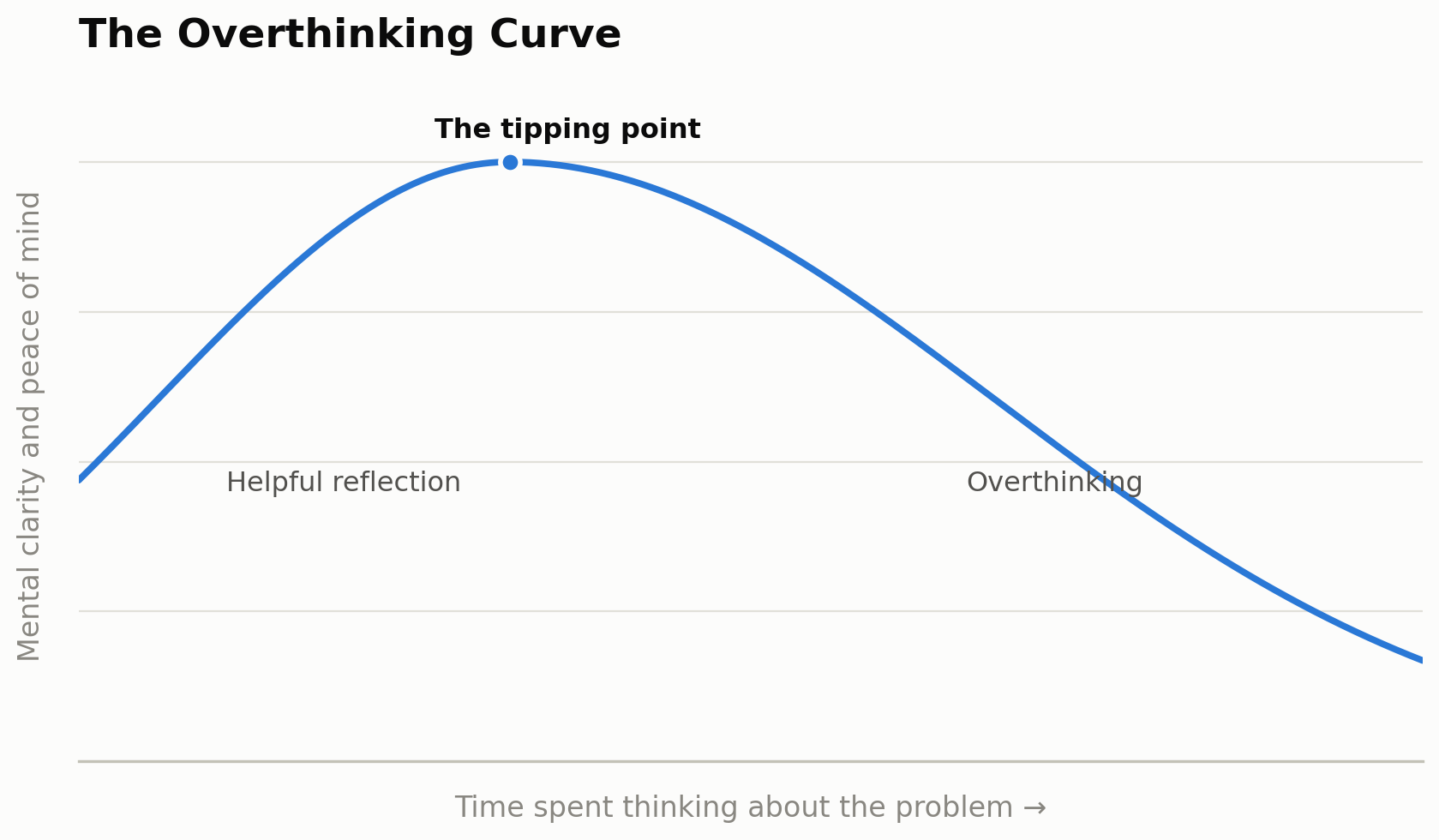
A curve showing mental clarity and peace of mind rising as reflection time increases, peaking at a tipping point, then declining as reflection turns into overthinking.
A little bit of thinking sharpens a decision. Too much of it starts to erode your clarity, your mood, and eventually your ability to act at all, as the chart above shows. If you want a gut check for where you personally sit on that curve, here is what tipping past the peak tends to look like.
| Sign | What it looks like in real life |
|---|---|
| Distraction | You read the same email three times because the same worry keeps looping through your head |
| Physical symptoms | Headaches, jaw tension, fatigue show up with no clear physical cause |
| Avoidance | You put off the email, the conversation, or the decision because thinking about it feels safer than acting on it |
| Analysis paralysis | You have all the information you need, yet you still cannot make the call |
| Seeking reassurance | You repeatedly ask a colleague, your partner, or anyone nearby the same question just to get temporary relief, like "Do you think that email sounded okay?" |
What you can actually do about it
The good news is that you do not need to silence your brain completely, you just need a process for working through the loop instead of living inside it. Here is the version I walk clients through.
| Step | How to apply it |
|---|---|
| 1. Acknowledge it | Notice that you are overthinking instead of fighting it or pretending it is not happening |
| 2. Name what you noticed, without judgment | "I have had this thought several times today." "When I said X, the VP said Y, stated an expectation, and did not give me positive feedback" |
| 3. Identify the emotion | "I feel nervous, worried, concerned" |
| 4. Note the assumption | "He is displeased with me." "I said something wrong." "I am going to get fired" |
| 5. Weigh the evidence | List what supports the assumption ("he flagged my performance last quarter") and what does not ("my last review was strong," "he told me earlier that he is stressed about something else") |
| 6. Reframe the thought* | Write it down, say it out loud, or ask what you would tell a friend in the same spot |
| 7. Monitor | Check in afterward. If the thought is still on repeat, go back through the exercise and look for more evidence |
That sixth step* deserves a bit more explanation, because it is backed by more than just good advice. Researchers studying what they call distanced self talk, meaning you coach yourself using your own name or the word "you" instead of "I," found that this small shift in language measurably reduces emotional reactivity across a wide range of stressful situations (Orvell et al., 2021). Asking yourself what you would tell a friend works for the same reason. It pulls you out of the tunnel vision of "I" and gives you the more useful, slightly detached view of a coach looking in from the outside.
Where to book virtual counselling to discuss overthinking in British Columbia or Alberta
If you read this whole thing nodding along, pay attention to that instead of brushing it off. Overthinking that is wrecking your sleep, your focus, or your ability to make decisions at work is reason enough to talk to someone, and you can do it without leaving your desk.
At Wellflow, I offer counselling and executive coaching, both virtually across British Columbia and Alberta, where I am a Registered Psychologist, and in-person in the Shipyards area in North Vancouver. Sessions focus on exactly the kind of pattern this article describes: anxiety, chronic worry, and the overthinking loop that keeps high performing people stuck in their heads instead of moving forward. You can book a virtual session directly through our online scheduler at wellflow.janeapp.com, or reach out to hello@wellflow.ca if you have questions.
Your mind is allowed to rest. It does not have to earn that rest by solving every problem first.
references
Chen, X., Chen, N.-X., Shen, Y.-Q., Li, H.-X., Li, L., Lu, B., Zhu, Z.-C., Fan, Z., & Yan, C.-G. (2020). The subsystem mechanism of default mode network underlying rumination: A reproducible neuroimaging study. NeuroImage, 221, Article 117185. https://doi.org/10.1016/j.neuroimage.2020.117185
Du Pont, A., Rhee, S. H., Corley, R. P., Hewitt, J. K., & Friedman, N. P. (2019). Are rumination and neuroticism genetically or environmentally distinct risk factors for psychopathology? Journal of Abnormal Psychology, 128(5), 385–396. https://doi.org/10.1037/abn0000430
Orvell, A., Vickers, B. D., Drake, B., Verduyn, P., Ayduk, O., Moser, J., Jonides, J., & Kross, E. (2021). Does distanced self-talk facilitate emotion regulation across a range of emotionally intense experiences? Clinical Psychological Science, 9(1), 68–78. https://doi.org/10.1177/2167702620951539
Sanchez-Escamilla, F., Redondo-Delgado, M., Jimenez-Ros, A. M., & Perez-Nieto, M. A. (2025). Metabeliefs about worry, cognitive fusion, and acceptance: Associations and mediations analysis. Frontiers in Psychology, 16, Article 1639105. https://doi.org/10.3389/fpsyg.2025.1639105
Sanders, W. A., & Lam, D. H. (2010). Ruminative and mindful self-focused processing modes and their impact on problem solving in dysphoric individuals. Behaviour Research and Therapy, 48(8), 747–753. https://doi.org/10.1016/j.brat.2010.04.007
Trapnell, P. D., & Campbell, J. D. (1999). Private self-consciousness and the five-factor model of personality: Distinguishing rumination from reflection. Journal of Personality and Social Psychology, 76(2), 284–304. https://doi.org/10.1037/0022-3514.76.2.284
Watkins, E. R. (2008). Constructive and unconstructive repetitive thought. Psychological Bulletin, 134(2), 163–206. https://doi.org/10.1037/0033-2909.134.2.163
Watkins, E., & Moulds, M. (2005). Distinct modes of ruminative self-focus: Impact of abstract versus concrete rumination on problem solving in depression. Emotion, 5(3), 319–328. https://doi.org/10.1037/1528-3542.5.3.319
Watkins, E. R., & Roberts, H. (2020). Reflecting on rumination: Consequences, causes, mechanisms and treatment of rumination. Behaviour Research and Therapy, 127, Article 103573. https://doi.org/10.1016/j.brat.2020.103573
Watkins, E., & Teasdale, J. D. (2004). Adaptive and maladaptive self-focus in depression. Journal of Affective Disorders, 82(1), 1–8. https://doi.org/10.1016/j.jad.2003.10.006
Zhou, S., Kwan, C. K., Ai, Y., & Ma, Y. (2025). Parent-adolescent intergenerational transmission of distress: The roles of family climate, adolescents' self-compassion and mindfulness. Frontiers in Psychology, 16, Article 1595515. https://doi.org/10.3389/fpsyg.2025.1595515