The Hustle Trap: Why Working Harder Is Quietly Costing You
Publish date: Friday, August 21, 2026 | Category: Executive Coaching | Read time: 6 min read | Author: Carolyn Charest, MC, MBA, CPHR, SHRM-SCP
The Hustle Trap: Why Working Harder Is Quietly Costing You
Picture the LinkedIn post that shows up at 4:47 am, cold plunge photo included, with a caption along the lines of "while you were sleeping, I was closing deals." It tends to rack up plenty of likes, and it also leaves plenty of readers, including some genuinely capable executives, quietly wondering if they are falling behind in life simply because they chose eight hours of sleep instead.
As a Registered Psychologist and executive coach with a background in HR, I want to be direct about something. Hustle culture is not something baked into someone's personality, it is a learned pattern, and patterns can be studied. When researchers actually study relentless overwork, the story is not "the harder you grind, the more you win." It is closer to a bell curve, where effort helps right up until it does not.
The belief that your worth as a person is measured by your output is the whole idea behind toxic productivity. It assumes that rest is a character flaw, and that if you are not exhausted you are not trying hard enough. It sounds like it could be motivating, but the research says otherwise.
What toxic productivity actually is
Workplace researcher Jennifer Moss, writing in the Harvard Business Review, defines toxic productivity as an unhealthy compulsion to be productive at all times, often at the expense of your mental health, your relationships, and your quality of life (Moss, 2024). Her research also found that weekly meetings jumped 192% after the pandemic, which means many executives are now busier than ever while getting less actual work done (Moss, 2024).
I want to emphasize that there is nothing wrong with waking up at 5 am. There is nothing wrong with ambition, discipline, or wanting to win. The problem starts when your sense of self worth becomes hostage to the routine. If missing your 5 am alarm once sends you into a spiral about being a failure then that is not discipline anymore; that is a trap.
Pep talks that backfire
Here is a finding that surprises most people: Telling yourself "I am amazing" does not automatically make you feel amazing, and for some people it makes things worse.
Psychologists first flagged this effect in a widely cited study out of the University of Waterloo, where people with low self esteem who repeated statements like "I am a lovable person" actually felt worse afterward than a control group who said nothing at all. The theory is that an unrealistic positive statement invites your brain to argue back. If you already doubt the statement, repeating it just gives your inner critic more material to work with.
This is not an argument against self encouragement. A large recent meta analysis in American Psychologist reviewed 129 studies and nearly 18,000 participants and found that self affirmation genuinely improves mood, life satisfaction, and a sense of belonging, with benefits lasting close to two weeks after the exercise (Zhang et al., 2025). The difference is what kind of affirmation. Reflecting on your actual values and real strengths works. Repeating a label you do not believe under pressure does not.
That distinction matters a lot for executives who were praised as "the smart one" or "the natural leader" early in their career. Psychologist Carol Dweck's ongoing research on mindset shows that praising a fixed trait, like being smart, can quietly teach people to protect that label instead of taking risks, because failure now threatens their identity rather than just their results (Dweck, 2019). A growth mindset, where you treat skills and intelligence as things you build rather than things you either have or do not, is the more durable foundation. You are allowed to not know something yet.
The other side of the coin
I want to be fair here, because the backlash to hustle culture has its own trap. Quiet quitting, doing the bare minimum and mentally checking out, is not the healthy antidote it sometimes gets marketed as. Gallup's workplace research found that about half of the United States workforce fits this pattern, with engagement dropping to 32% and active disengagement climbing to 18%, the lowest ratio of engaged to disengaged workers in almost a decade (Gallup, 2022).
Toxic productivity and quiet quitting behave like a pendulum swinging between two extremes of the same underlying problem, both forms of all or nothing thinking where a person moves from doing everything to doing as little as possible, with no comfortable middle ground in between. Burn out hard enough on one side, and the other side can start to look like relief, but it usually is not, it is just a different flavor of exhaustion.
Compare and despair
Let us talk about the scroll. You open LinkedIn to check a message, and forty minutes later you have seen three promotions, one acquisition, and a former colleague announcing they just ran a marathon before their 6 am board call. This is where a cognitive distortion called compare and despair takes hold. You are quietly comparing your full, complicated, behind the scenes life to everyone else's carefully edited highlight reel, and you are losing.
Research published in Frontiers in Public Health followed 530 working adults and found a real link between heavy social media use and job burnout, and that effect grew stronger the more people engaged in social comparison (Han et al., 2020). The comparison itself was not the whole problem. It was the combination of constant scrolling plus constant measuring yourself against other people's highlight reels that did the damage.
If this sounds familiar, you are not imagining it and you are not behind. You are looking at a feed that was built to show you the best five minutes of everyone else's month.
Since when did sleep become optional
At some point along the way, needing sleep quietly got rebranded as a weakness. It is worth asking when that happened, because it certainly is not backed by biology. Every one of us needed sleep to grow a functioning brain as an infant, and that requirement never expired just because we started wearing a blazer to work.
A study published in Scientific Reports used brain imaging to show that sleep deprivation measurably impairs cognitive performance and alters the blood flow patterns your brain relies on for focused thinking (Csipo et al., 2021). After just one night with no sleep at all, participants showed slower reaction times and weaker sustained attention, along with changes in cerebral blood flow. In plain terms, the sharp, decisive version of you that your team needs in a big meeting does not show up after a night with no sleep. Skipping sleep to look committed is not discipline. You are giving up the mental sharpness you will need tomorrow just to look dedicated tonight.
What actually works
The good news is that none of this requires you to quit your job and take up pottery, or abandon ambition altogether. It requires a slightly different operating system.
A 2022 experimental study out of the University of New South Wales tested SMART goal setting, meaning goals that are Specific, Measurable, Attainable, Realistic, and Timely, against no structured goal at all. The group using SMART goals reported about 73% goal attainment compared to 64% in the control group, along with higher positive affect (Bahrami et al., 2022). The key detail researchers flagged is that the goals worked best when they were also self concordant, meaning they connected to something the person actually valued, not just a metric handed down from above.
That is the throughline across all of this evidence: structure helps, values based reflection helps, and rest helps. What does not help is treating your worth as a person as something you have to re earn every single day through output.
The Chart
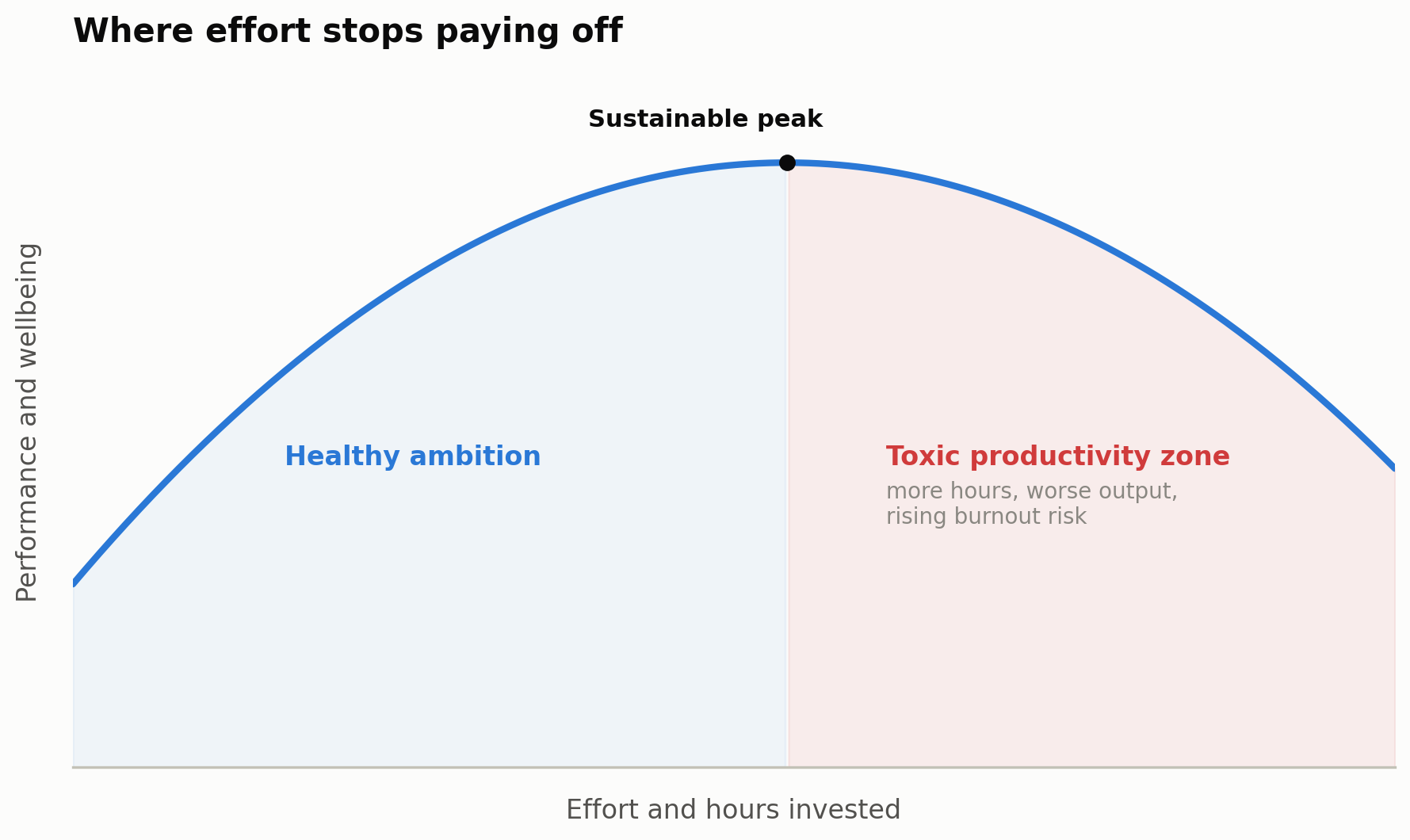
Performance and wellbeing rise with effort up to a sustainable peak, then decline once effort tips into the toxic productivity zone, marked by more hours, worse output, and rising burnout risk.
Effort and performance do not move in a straight line, they follow a curve, and a 2024 study in Trends in Cognitive Sciences backs this up: performance peaks at a moderate level of effort and drops off once effort runs too low or too high (Nieuwenhuis, 2024). In a work setting, that curve shows up past a certain point, when more hours stop producing more results and start producing more mistakes, more turnover, and more sick days. The goal is not zero effort, it is finding your peak and staying near it on purpose.
Warning signs you may be sliding into toxic productivity
| Warning sign | What it looks like in real life |
|---|---|
| Your feed is full of "maxing" content | Accounts built around extreme discipline, cold plunges, and 4 am wake up posts start to feel like a standard you are failing to meet |
| Sleep is the first thing you cut | You treat rest as optional overhead instead of a requirement for clear thinking |
| Your schedule has no flexibility | A missed workout or a late start derails your entire sense of the day, not just your plan for it |
| Your goals are vague or all encompassing | "Be more productive" or "crush it this quarter" instead of something specific and realistic |
| Your identity rides on the label | Being "the smart one" or "the hardest worker" feels like something you must defend, not something you simply are |
| Step | How to apply it |
|---|---|
| Set SMART goals tied to your values | Before locking in a quarterly goal, ask what it actually connects to for you, not just what it looks like on a scorecard |
| Build in a real recovery window | Protect sleep and at least one full stop each week the same way you would protect a client meeting |
| Swap blanket affirmations for honest reflection | Instead of "I am amazing," try "here is one thing I did well this week and why it mattered" |
| Audit your feed | Mute or unfollow accounts that consistently leave you feeling behind rather than informed |
| Normalize rest out loud | As a leader, say when you are logging off. Your team is watching your behavior more than your policy |
The bottom line
Toxic productivity sells you a lie wrapped in a compliment. It tells you that your value is tied to your output, that exhaustion is proof of commitment and that rest has to be earned. None of that holds up against the evidence, and none of it is sustainable at the level senior leaders need to operate at for years, not months.
If you recognize yourself in this article then you are not broken and you are not behind. You are running an operating system that a lot of very smart, very driven people were handed without ever agreeing to it, and it can be updated.
At Wellflow, this is the kind of work I do with executives and leadership teams every day, helping high performers rebuild a relationship with work that is sustainable instead of self destructive. If any part of this article felt uncomfortably familiar, reach out to book a session. The best years of your career should not come at the cost of the worst years of your health.
References
Moss, J. (2024). Let's End Toxic Productivity. Harvard Business Review. hbr.org/2024/11/lets-end-toxic-productivity
Nieuwenhuis, S. (2024). Arousal and performance: revisiting the famous inverted U shaped curve. Trends in Cognitive Sciences. cell.com/trends/cognitive-sciences/fulltext/S1364-6613(24)00078-0
Zhang, Y. et al. (2025). The impact of self affirmation interventions on well being: A meta analysis. American Psychologist, summarized via EurekAlert. eurekalert.org/news-releases/1103170
Dweck, C. S. (2019). The Choice to Make a Difference. Perspectives on Psychological Science. journals.sagepub.com/doi/10.1177/1745691618804180
Gallup (2022). Is Quiet Quitting Real? gallup.com/workplace/398306/quiet-quitting-real.aspx
Han, R. et al. (2020). The Impact of Social Media Use on Job Burnout: The Role of Social Comparison. Frontiers in Public Health. pmc.ncbi.nlm.nih.gov/articles/PMC7710858
Csipo, T. et al. (2021). Sleep deprivation impairs cognitive performance, alters task associated cerebral blood flow, and decreases cortical neurovascular coupling related hemodynamic responses. Scientific Reports. nature.com/articles/s41598-021-00188-8
Bahrami, Z. et al. (2022). Applying SMART Goal Intervention Leads to Greater Goal Attainment, Need Satisfaction and Positive Affect. International Journal of Mental Health Promotion. techscience.com/IJMHP/v24n6/49942/html